Heat recovery in industrial refrigeration: turning thermal waste into an energy resource
In industrial refrigeration systems, cold is produced by transferring heat from one fluid to another. The refrigeration cycle removes thermal energy from the area to be cooled and expels it outside through condensers or evaporative towers.
Traditionally this heat is dissipated into the atmosphere. In energy terms it is therefore an unavoidable by-product of the refrigeration process, but also a form of energy already paid for through the compressors’ electricity consumption.
In many industrial plants, the amount of heat expelled by the refrigeration cycle is comparable to, or even greater than, the thermal demand of some of the plant’s services. Recovering it means turning an energy flow normally wasted into a useful resource for other production processes.
For this reason, heat recovery is today one of the pillars of energy-efficiency strategies in industrial refrigeration plants.
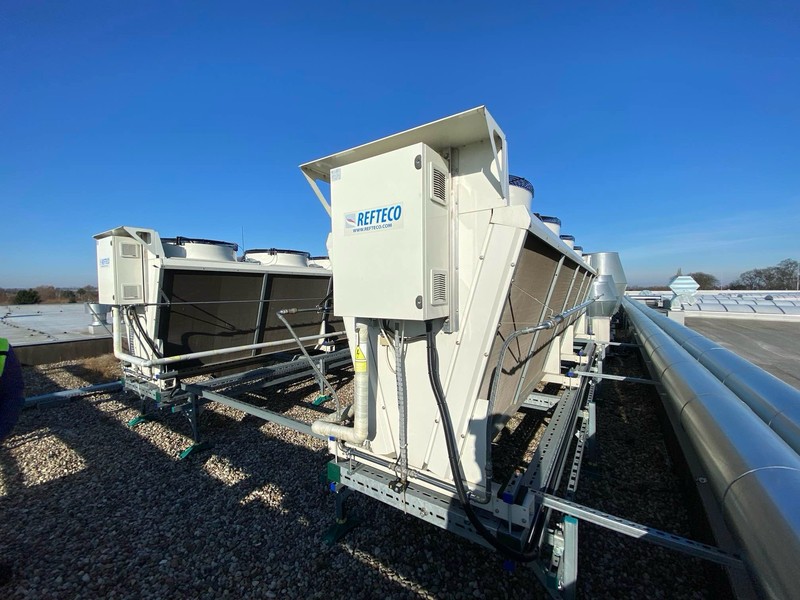
Where heat is generated in the refrigeration cycle and how to recover it
To understand the potential of heat recovery in refrigeration plants, we need to look at where and how energy is released within the compression cycle.
The first point where heat is generated is the compressor. At the compressor outlet, the refrigerant gas is at high pressure and high temperature. Part of this energy can be recovered by installing a desuperheater between compressor and condenser — a heat exchanger that intercepts part of the discharge-gas heat to produce hot water.
A second energy source is the condensation heat. As the refrigerant passes from gas to liquid, it releases a significant amount of energy to the condenser. This energy is generally available at more moderate temperatures, making it particularly attractive for heat recovery — often to produce domestic hot water. In some configurations it is possible to achieve total recovery on the condenser, diverting the thermal flow to a usage circuit and carefully managing the balance between cooling demand and heat demand.
A further evolution is integration with industrial heat pumps, which use the cooling circuit as a heat source to raise the temperature of the recovered heat to levels useful for more demanding industrial processes.
In some applications, adiabatic condensation systems also indirectly help improve heat-recovery efficiency, stabilising the condensing temperature and making energy availability more predictable. Solutions such as Refteco adiabatic condensers with the RCVM-AD spray system or RCVM-PAD system lower the temperature of the air entering the coil during summer peaks, limiting the rise in condensing pressure and improving the operating conditions of the refrigeration cycle.
Finally, there are secondary thermal contributions that can be recovered in some plant configurations, such as the heat generated by the lubrication systems of screw compressors or that dissipated by the electric motors.
Applications of the recovered heat
Reusing the recovered heat depends mainly on the available temperature and the plant’s needs.
One of the most immediate applications is the production of domestic hot water, used for services such as changing rooms, canteens and offices. In many industrial plants this demand can be covered almost entirely by the heat recovered from the refrigeration cycle.
The heat can also be used for space heating, for example through air-handling units or radiant systems installed in logistics warehouses.
In the food sector, heat recovery finds particularly interesting applications in production-line sanitisation processes, such as CIP (Cleaning In Place) systems, where hot water is required continuously.
Another frequent use is the preheating of boiler feed water, reducing fuel consumption in steam generators.
In some refrigeration plants the recovered heat is also used to feed hot-glycol defrost systems for the evaporators. This approach makes it possible to reuse energy otherwise dissipated by the condenser, eliminating the need for electric heaters and thus reducing defrost consumption and the thermal load introduced into the cold room.
This solution has been adopted in several Refteco projects: in the processing of berries in Verona, for example, the freezing rooms were equipped with CO₂ evaporators with hot-glycol defrost, using condensation-heat recovery to maintain a high system COP.
A similar approach was adopted in the plant for the storage of kiwifruit and plums in Cisterna di Latina, where industrial cubic RN unit coolers, RDS–RDL flat liquid coolers and RCSD–RCLD flat condensers are integrated into a hot-glycol circuit fed by condensation-heat recovery, reducing the energy consumption associated with defrost cycles.
The same principle was applied in the revamping of a large-retail logistics platform in Anzola dell’Emilia, where the installation of new commercial cubic CO₂ evaporators with hot-glycol defrost and RGDI industrial dual-flow air coolers made it possible to eliminate ice-formation problems and improve overall energy efficiency thanks to the refrigeration cycle’s heat recovery.

Technical challenges and design best practices
Although the potential of heat recovery is high, integrating it with the refrigeration cycle requires some design care.
One of the most critical aspects is the simultaneity between cooling demand and heat demand. In some cases it may be necessary to use thermal storage tanks to temporarily store the recovered energy and make it available when required.
The choice of heat-exchanger materials must also be assessed carefully, especially in plants using natural refrigerants such as CO₂ or ammonia, or operating in potentially corrosive environments.
Finally, heat-recovery systems must be integrated with control and automation logic that always ensures the operational priority of the refrigeration cycle, avoiding interference with the plant’s safety and stability.
In modern industrial plants, the amount of thermal energy generated by the refrigeration cycle makes heat-recovery systems potential energy hubs within the facility.
Recovering and reusing heat means reducing overall consumption, improving energy efficiency and contributing to the sustainability goals increasingly required by industry.
At Refteco we analyse the refrigeration cycle as a whole to identify heat-recovery opportunities integrated with the design of heat exchangers and cooling systems.
If you are designing a new refrigeration plant or considering the energy optimisation of an existing one, share your operating data and the facility’s thermal needs with us: heat recovery can turn a wasted energy flow into a concrete resource for the plant’s efficiency.

REFrigeration TEchnological COmponents
For more information