CO₂ unit coolers and gas coolers: mechanical design criteria for reliable transcritical systems
The shift to natural refrigerants is profoundly changing the way industrial refrigeration systems are designed. While with ammonia (as we saw in the previous article) the main challenge is material compatibility and long-term mechanics, with CO₂ the paradigm changes: it is operating pressure that drives every construction choice.
In transcritical CO₂ systems (now widely used in large-scale retail, food distribution and medium-capacity industrial plants), the low critical point (31 °C) means that, for much of the year and especially in the summer months, the system quickly moves past the condensing zone, operating in transcritical mode at very high pressures. This is where the main engineering complexities come from:
- rapid pressure variations as a function of outdoor temperature,
- intense thermal cycles that stress the coil and welds,
- hot-gas defrosts that generate pressure peaks,
- a hot side that can exceed 90–100 bar.
CO₂ is an efficient, sustainable and reliable refrigerant, but also one of the most structurally demanding: it requires heat exchangers designed specifically to operate at high pressure, not adaptations of models originally designed for HFCs or ammonia.
In this deep-dive we therefore get to the heart of the engineering of unit coolers and gas coolers built specifically for transcritical CO₂: materials, geometries, design pressures and construction solutions that ensure stability and durability in modern systems.
Carbon dioxide (CO₂): the pressure challenge in transcritical systems
CO₂ has revolutionised industrial and commercial refrigeration. Its very low GWP makes it a direct response to F-Gas regulations, but it introduces a unique technical complexity: operating pressure.
In transcritical systems, the low critical point of CO₂ (31 °C) means the circuit pressure rises quickly with outdoor temperature, reaching very high values especially in summer. That is why you need heat exchangers designed specifically for CO₂, able to guarantee service continuity and consistent performance in every operating condition.
Cold side: CO₂ unit coolers for pressures from 60 bar to 80 bar on request
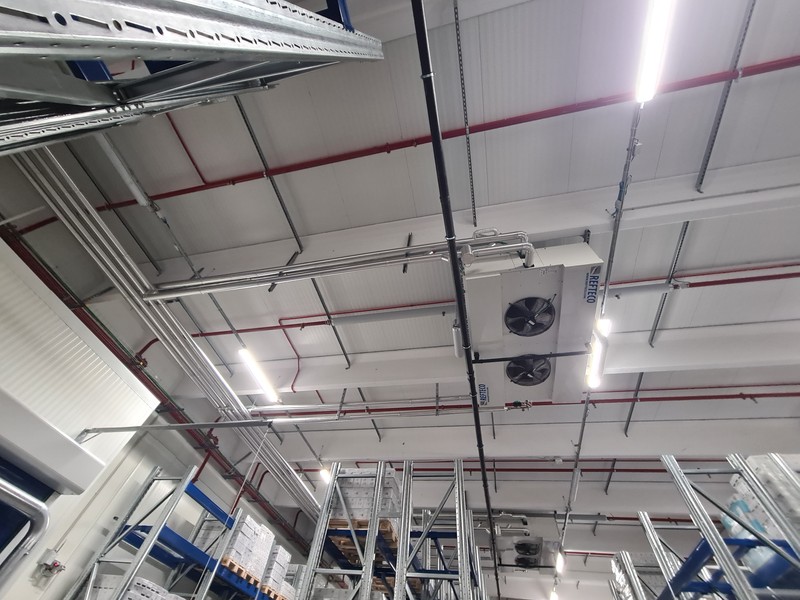
In Refteco CO₂ unit coolers (from storage cold rooms to blast freezers and shock freezers), the coils are designed for 60 bar design pressures as standard, with the option to reach 80 bar on request for particularly demanding applications.
These values reflect real operating scenarios:
- hot-gas defrosts,
- pressure peaks during stop&go,
- the rapid cycles typical of industrial tunnels,
- significant thermal swings.
Why high-pressure design is needed
In high-intensity applications such as rapid-freezing tunnels, unit coolers designed for 60–80 bar make it possible to:
- avoid unwanted safety-valve tripping during defrost;
- limit stress on the welds;
- maintain reliability even in demanding applications such as CO₂ blast freezers;
- extend CO₂’s application range to process cold rooms and dynamic warehouses too.
CO₂ is thus no longer confined to storage cold rooms alone, but can also be used in extreme processes, where high specific capacities and intensive cycles demand heat exchangers with high mechanical robustness. The same design logic is in fact applied across the entire Refteco unit-cooler range (cubic, dual-flow, blast freezer and floor-mounted units) in CO₂-dedicated versions, to cover the whole cold chain with the same level of mechanical robustness.

Hot side: 120 bar gas coolers in K65 alloy with adiabatic options for critical climates
The most critical front of transcritical CO₂ remains the hot side, the most stressed part of the system. Here, gas coolers must withstand:
- operating pressures up to 120 bar;
- gas temperatures up to 140 °C;
- repeated expansion and contraction cycles.
For these reasons, in its gas coolers Refteco uses K65 copper-alloy tubes, a material developed specifically for high-pressure applications, combining thermal conductivity with mechanical strength superior to traditional alloys.
And for hotter climates, Refteco has developed adiabatic variants of the V-shaped gas coolers (RKVM series), in two complementary configurations:
- RKVM-AD, with targeted spray activation that kicks in only during summer peaks;
- RKVM-PAD, with evaporative panels for continuous pre-cooling of the air.
These solutions help contain pressure, stabilise the COP and ensure operational continuity even on the most critical days.
The same solutions apply both to high-capacity plants for logistics platforms and to urban installations, where low-profile, low-visual-impact machines are required, always keeping the high-pressure construction philosophy typical of Refteco.

Designing for CO₂ means making sure evaporators and gas coolers keep their mechanical stability and performance even under extreme stress. It is in these conditions that the difference emerges between a “compatible” product and one truly designed for the refrigerant.
The Refteco philosophy stems from exactly this principle: every construction choice must translate into reliability that is measurable over time. Whether it’s evaporators or gas coolers, the goal is always to offer heat exchangers capable of withstanding the real operating conditions of modern CO₂ systems.
If you’re planning a new system or a revamp for your cold-chain logistics, food & beverage or food business, our technical department is on hand to analyse pressures, loads, installation limits and seasonal strategies, turning complex requirements into solutions engineered to last.

REFrigeration TEchnological COmponents
For more informations