Ammonia (NH₃) unit coolers: mechanical design criteria for reliable industrial systems
In just a few years, natural refrigerants have gone from an “alternative option” to a full-blown design standard. CO₂ (R744) is now the benchmark for large-scale retail and is making decisive inroads into industry too; ammonia (NH₃ / R717) has been the refrigerant of choice for high-capacity applications and cold-chain logistics for over a century.
This shift isn’t only about regulation: CO₂ and NH₃ have physical and chemical properties that first and foremost demand a return to mechanical engineering. Ammonia, in particular, is thermodynamically excellent, yet incompatible with copper and unforgiving of construction errors.
In this context, parameters such as tube thickness, alloy type, coil geometry, suspension systems, defrost method and thermal-expansion management become as important as the rated kW.
That is why Refteco doesn’t simply offer “NH₃ versions” of existing products: we have developed a dedicated construction line of heat exchangers for natural refrigerants, built on
- premium, long-term-compatible materials (stainless steel for ammonia);
- targeted structural sizing, with declared and verifiable minimum thicknesses;
- coil geometries designed to handle frost, defrost cycles and demanding duty cycles;
- high design pressures, in line with the real-world conditions of modern systems.
It is through materials engineering and construction detail that Refteco systems become a long-term guarantee.
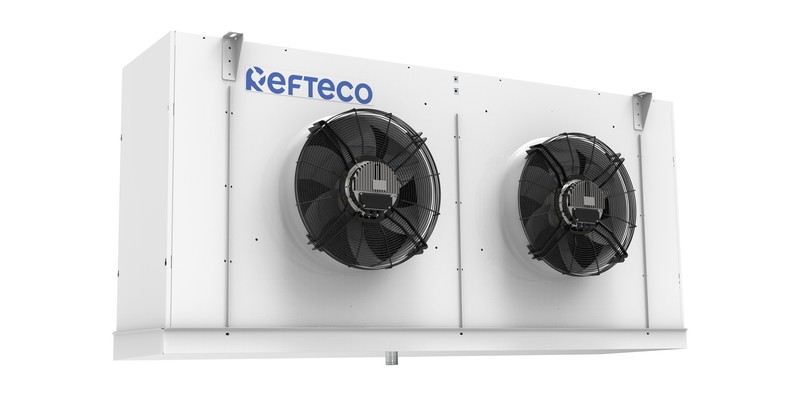
Ammonia (NH₃): the corrosion challenge
Ammonia is the most widely used natural refrigerant in high-capacity industrial systems such as large storage cold rooms, automated platforms and low-temperature warehouses. It delivers high cooling capacity with reduced refrigerant flow rates, maintaining strong efficiency even at low evaporating temperatures.
At the same time, though, ammonia is incompatible with copper and requires stainless steel or aluminium in every part that contacts the refrigerant. Heat-exchanger reliability therefore depends on material quality: unsuitable alloys can, over time, generate micro-leaks or corrosion, compromising system safety.
Premium materials: stainless steel dedicated to ammonia
In ammonia (NH3) unit coolers, the coil structure must be engineered “around” the refrigerant.
In the Refteco series dedicated to NH₃ (such as industrial single-flow RNLA, industrial dual-flow RADI, horizontal-coil RAF), the coils are built entirely in AISI 304 stainless steel, with AISI 316L available for particularly exposed applications or corrosive environments.
This approach makes it possible to:
- preserve tube integrity over the long term,
- reduce the risk of thinning or micro-corrosion,
- keep operating pressure and mechanical stress always within safety margins.

“Over-engineered” thickness
In ammonia versions, tube thickness is another decisive factor in the coil’s mechanical stability during defrost cycles and rapid thermal transitions.
That is why Refteco uses stainless steel tubes with a 16 mm diameter and a minimum thickness of 0.7 mm. A high value compared with the 0.5–0.6 mm used by many manufacturers, but not to “over-size” for its own sake. Greater thickness:
- absorbs expansion better,
- reduces stress on the welds,
- preserves tube geometry even after thousands of hot/cold cycles.
The upshot is practical: fewer chances of micro-leaks, greater stability over time, fewer emergency call-outs. In NH₃ systems, even a single shutdown can be worth hundreds of thousands of euros: details like these become strategic choices.
Functional geometry: the square coil for large warehouses
In large industrial evaporators, coil geometry directly affects frost management and airflow stability.
For ammonia units, Refteco offers square-geometry versions (RN industrial cubic unit coolers and RADI industrial dual-flow unit coolers), with tubes aligned on both vertical and horizontal pitch.
This delivers:
- a large heat-exchange surface,
- more uniform frost distribution,
- less airflow penalty during the cycle,
- greater stability in large low-temperature logistics cold rooms.
In this scenario, the coil is not just a heat-exchange element, but an active tool in managing product quality and optimising energy consumption.

Designing with NH₃: building around the refrigerant
Designing for ammonia cooling doesn’t mean adapting an existing heat exchanger: it means rethinking it around the refrigerant’s physical constraints, the thermal cycles and the system layout.
And this is exactly where Refteco engineering comes in, in the pursuit of maximum long-term stability: every Refteco heat exchanger is sized on the real operating conditions of the system to protect the product, ensure operational continuity and reduce risk.
For cold-chain logistics, food & beverage, fresh produce and the food industry, this means being able to rely on systems that not only meet regulations, but protect product quality and optimise consumption.
Contact us for all your design needs: our technical department is on hand to assess real pressures, thermal conditions and installation constraints, turning them into heat exchangers engineered to last.

REFrigeration TEchnological COmponents
For more informations