A guide to revamping in industrial refrigeration: modernising for efficiency, reliability and sustainability
In industrial refrigeration plants, revamping is often the only way to maintain energy efficiency, operational continuity and regulatory compliance.
Two factors are accelerating this transition:
- Regulation: the F-Gas Regulation (EU 2024/573) is progressively reducing the availability of high-GWP refrigerants such as R-404A and R-507. Beyond the growing market restriction, these fluids face ever-higher costs and application constraints that make their use less and less sustainable in the short and medium term.
- The second factor is technological. Many plants installed 15–20 years ago were designed with standardised sizing logic, often oriented to initial CAPEX rather than Life Cycle Cost optimisation. Over time, the degradation of exchange surfaces, component obsolescence and rigid control logic lead to a progressive rise in energy consumption and a reduction in overall reliability.
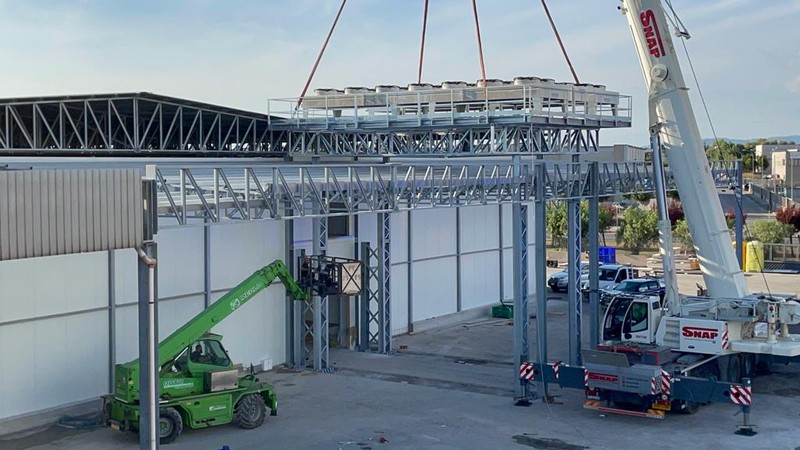
Revamping makes it possible to act on these factors without fully replacing the plant. Through a combination of hardware upgrades, thermodynamic optimisation and control digitalisation, it is possible to reduce OPEX, improve the stability of the refrigeration process and extend the useful life of the existing infrastructure.
The warning signs: when a plant has become obsolete
An industrial refrigeration plant rarely stops working suddenly. More often, obsolescence shows up through gradual signals that indicate a deterioration in energy and mechanical performance.
One of the first indicators is the rise in specific energy consumption. Over time, the degradation of heat-exchange surfaces and frost build-up on the evaporators force the system to work with higher operating ΔT. This leads to a lower evaporating temperature and a higher compression ratio, with a consequent increase in the compressors’ electrical power absorption.
A second signal is the excessive frequency of defrosts. In many older plants, defrosting is managed with time-based logic that does not account for the coil’s real conditions. This generates inefficient defrost cycles, introducing artificial thermal loads and microclimate instability inside the cold rooms.
Finally, obsolescence also emerges on the mechanical and structural side. Refrigerant micro-leaks, fin corrosion and fan vibrations are often indicators of components that have reached the end of their economic life cycle.
When these phenomena combine, the plant’s Life Cycle Cost rises quickly and revamping becomes the most rational solution from a technical and economic standpoint.
Revamping: tailor-made design in 4 phases
Phase 1: technical diagnosis and Life Cycle Cost analysis
Every effective revamping starts with a phase of thorough diagnosis. The goal is not to replace components indiscriminately, but to identify the points of the plant where acting delivers greater efficiency and reliability.
The first step is therefore a technical audit of the refrigeration plant, which compares the nominal cooling capacity with what is really available in operation. By measuring temperatures, pressures and airflows, it is possible to identify any critical points in the refrigeration cycle.
In parallel, it is necessary to analyse the environmental conditions in which the heat exchangers operate. The presence of salt spray or aggressive detergents can accelerate the corrosion of finned coils and influence the choice of materials for the new components.
This phase concludes with the Life Cycle Costing (LCC) assessment. By analysing energy consumption, maintenance costs and plant downtime, it is possible to estimate the economic return of the work. In many cases, the energy saving achieved with modern components allows the initial investment to be absorbed within 24–36 months.

Phase 2: strategic hardware interventions
Once the plant’s critical points have been identified, revamping can focus on the elements that most affect the refrigeration system’s performance.
One of the most effective interventions is replacing the unit coolers with models designed for harsher operating conditions. Finned coils with wider spacing and more corrosion-resistant materials allow more stable frost management, reduce the frequency of defrosts and preserve heat-exchange performance over time.
In particularly aggressive environments, the use of stainless steel tubing and aluminium-magnesium (AlMg) alloy fins further improves the exchanger’s durability and reduces the risk of early degradation of the exchange surfaces.
A concrete case is the renovation of a large-retail logistics platform in Anzola dell’Emilia, where the existing evaporators had recurring problems of ice formation and inadequate performance. Replacement with new-generation Refteco units made it possible to stabilise the cold rooms’ operation and improve the plant’s overall efficiency.
A similar intervention was carried out in a banana-ripening plant in Utzenstorf (Switzerland), where the existing unit coolers were replaced with two new high-efficiency units. The retrofit made it possible to improve microclimate stability in the ripening rooms and reduce the plant’s energy consumption.
A second area of intervention is ventilation. Integrating fans with modulating EC motors (0–10V) allows the airflow to be adapted to the real thermal load. Given the relationship between speed and absorbed power, regulation at partial loads significantly reduces electricity consumption while also improving the plant’s acoustic comfort.
Phase 3: thermodynamic optimisation and refrigerants
The transition to natural refrigerants such as CO₂ (R744) or ammonia (NH₃) reduces the plant’s environmental impact and anticipates regulatory restrictions on high-GWP fluids. However, these refrigerants require heat exchangers designed for different operating conditions, such as significantly higher pressures in the case of CO₂.
A further improvement can come from adopting adiabatic systems on the condensers. Using PAD systems or spray systems makes it possible to stabilise the condensing temperature in summer, improving the plant’s COP.
A significant application case is a packaging production site in Tczew (Poland), where replacing an evaporative cooling tower with two V-shaped dry coolers fitted with an adiabatic spray system drastically reduced water consumption and improved the cooling system’s energy efficiency.
Defrost management can also be optimised during a revamping intervention. Using hot gas or hot glycol instead of energy-hungry electric heaters reduces the thermal load introduced during defrost cycles and improves the refrigeration system’s overall efficiency.

Phase 4: digitalisation and intelligent control
In the most modern plants, efficiency depends not only on the hardware components but also on the quality of the control system.
Introducing on-demand defrost logic based on Δp or ΔT sensors makes it possible to trigger defrosting only when needed, avoiding pointless cycles and improving the cold rooms’ thermal stability.
In parallel, integrating systems for remote monitoring makes it possible to collect operating data in real time. Through predictive-maintenance algorithms, anomalies can be identified before they turn into critical failures, reducing the risk of plant downtime.
Every revamping intervention is a unique project. Existing plants have layout constraints, flow geometries and operating conditions that cannot be addressed with standard solutions.
For this reason, retrofitting an industrial refrigeration system requires a thorough study of the plant, the air distribution and the integration with the existing infrastructure.
In some cases revamping accompanies the expansion of facilities, as with the frozen-snack production plant in Agios Stefanos (Greece). In others, it concerns increasing the storage capacity of already-operating facilities, as in the case of a fruit-and-vegetable centre in Cisterna di Latina, where new high-efficiency cold rooms were integrated into the existing structure.
At Refteco we support designers and operators in defining tailor-made revamping solutions, analysing operating data, environmental conditions and architectural constraints to optimise the existing refrigeration cycle.
If you are considering upgrading an industrial refrigeration plant, share your operating data and running conditions with us: a correctly designed revamping can reduce energy consumption, improve system reliability and significantly extend the plant’s useful life.

REFrigeration TEchnological COmponents
For more information