Guide to choosing an industrial unit cooler (part 2): natural refrigerants and evaporator design
In the first deep-dive we analysed how operating ΔT, exchange surface and air dynamics directly influence the performance of an industrial refrigeration plant, in terms of energy efficiency, thermo-hygrometric stability and operating costs.
Alongside these variables, however, there is a further structural factor: the refrigerant.
The transition to natural refrigerants, accelerated by the F-Gas Regulation and the progressive reduction of high-GWP fluids, is substantially changing evaporator design criteria. The choice of refrigerant affects the evaporating temperatures actually achievable, the fluid distribution within the coils, the circuit geometry and the material selection, with direct effects on the plant’s average seasonal efficiency.
In this second article we analyse the design implications of NH₃ (ammonia), CO₂ (R744) and secondary fluids, highlighting how the choice of refrigerant is closely connected to the unit cooler’s configuration.
Ammonia (NH₃): thermodynamic efficiency and construction rigour
Ammonia (NH₃) remains the benchmark in medium- and high-capacity industrial refrigeration. Its zero GWP, combined with particularly favourable thermophysical properties, ensures a high refrigerant-side exchange coefficient and modest pressure drops compared with many synthetic fluids.
In energy terms, this translates into the possibility of working with higher evaporating temperatures and lower ΔT for the same surface, with direct benefits for COP, specific energy consumption and average seasonal efficiency.
Thermodynamic efficiency, however, does not eliminate the construction complexities. An ammonia evaporator requires:
- steel tubing,
- qualified welds,
- careful control of oil return,
- uniform refrigerant distribution.
In multi-circuit or large-scale plants, non-uniform distribution can generate feed imbalances, partially dry zones and a progressive decline in performance.
With NH₃, therefore, thermodynamic efficiency is high, but it requires a unit-cooler design consistent with the fluid’s characteristics and the plant’s real management.
CO₂ (R744): high pressures, high-precision design
CO₂ (R744) is one of the pillars of the transition to natural refrigerants, thanks to its GWP of 1 and the growing adoption of subcritical, booster and transcritical systems.
Unlike ammonia, CO₂ introduces significantly higher operating pressures and greater sensitivity to pressure drops. The fluid’s thermophysical properties make the system more responsive to load variations and more demanding in terms of design precision.
In sizing a CO₂ evaporator, the following become decisive:
- thicknesses suited to the operating pressures,
- the configuration of the headers,
- the uniformity of refrigerant distribution,
- the prevention of dry-out phenomena.
In this context, small design deviations can translate into evaporation instability, output fluctuations and penalties on seasonal energy efficiency.
With R744, precision is not an enhancing factor: it is a structural requirement.
Secondary fluids: plant safety and impact on ΔT
Using secondary fluids – such as glycol or brines – introduces a separation between the primary circuit and the refrigerated environment, reducing risk in occupied areas and simplifying safety management.
From a thermodynamic standpoint, however, this solution involves an intermediate heat exchange that substantially changes the evaporator’s sizing.
The increase in the overall temperature difference tends to translate into:
- an increase in the air-side ΔT,
- a greater exchange surface required,
- additional pumping losses,
- an impact on the average seasonal efficiency.
The result is a generally safer configuration, but potentially less energy-efficient if not correctly optimised.
Choosing a secondary fluid is therefore not neutral: it directly changes the dimensions, configuration and Life Cycle Cost of the industrial air cooler.
| Design parameter | NH₃ (Ammonia) | CO₂ (R744) | Secondary fluids (glycol/brines) |
|---|---|---|---|
| GWP | 0 | 1 | Depends on the primary refrigerant |
| Operating pressures | Moderate | Very high | Moderate (separate primary circuit) |
| Evaporating temperature | Generally higher | Sensitive to pressure drops | Penalised by the intermediate heat exchange |
| Operating ΔT | Lower for the same surface | Depends on the plant configuration | Tends to be higher on the air side |
| Sensitivity to distribution | Medium | High | Low on the air-cooler side |
| Materials required | Steel, qualified welds | High mechanical strength | Materials compatible with the secondary fluid |
| Design complexity | High (oil and safety) | High (pressures and dry-out) | High on the plant side (pumping) |
| Impact on seasonal COP | Generally favourable | Variable (depends on the cycle) | Potential penalty |
| Impact on LCC | Good if well designed | Excellent if optimised | Depends on pumping losses |
Materials, corrosion and performance stability over time
The refrigerant affects not only ΔT and pressures, but also the choice of materials. However, chemical compatibility with the fluid is only part of the problem. In industrial refrigeration, the evaporator’s materials must also respond to the environmental conditions in which the unit operates.
In food or aggressive environments – ageing rooms, the presence of salt, organic acids, high-humidity atmospheres or chloride loads – evaporator corrosion is not an accessory phenomenon, but a primary design variable.
The traditional combination of copper tube and aluminium fin can trigger galvanic corrosion, especially in the presence of condensation and contaminants. The problem is not only mechanical. Corrosion progressively alters the effective exchange surface and changes the overall coefficient k.
When k reduces, to maintain the same cooling capacity the evaporator is forced to work with higher operating ΔT. This entails:
- a lower evaporating temperature,
- a reduction in COP,
- an increase in specific energy consumption,
- a rise in OPEX in the medium term.
The degradation is not sudden, but progressive. And it is precisely this gradualness that makes it economically insidious.
Material selection therefore becomes a plant choice, not just a construction one. The use of stainless steel tubing, aluminium-magnesium (AlMg) alloy fins or surface treatments such as epoxy painting or cataphoresis (KTL) makes it possible to preserve over time not only the mechanical integrity, but above all the stability of the thermal performance.
The distinction between 304 and 316L stainless steel is also not marginal. In the presence of chlorides or marine atmospheres, 316L offers greater resistance to pitting and crevice corrosion, reducing the risk of performance decay over the medium-to-long term.
The durability of an industrial unit cooler for the cold chain is not measured only in years of service, but in its ability to maintain the design conditions over time: cooling output, evaporating temperature and energy efficiency envisaged at the sizing stage.

The transition to natural refrigerants is not just an adaptation to the F-Gas Regulation.
It is a structural change in the way industrial refrigeration is designed.
With NH₃, CO₂ or secondary fluids, it is not only the fluid that changes: the pressures, the real evaporating temperatures, the refrigerant distribution, the construction materials, the stability of ΔT over time and, consequently, the plant’s Life Cycle Cost all change.
The choice of refrigerant is therefore, to all intents and purposes, a choice of evaporator configuration.
Designing an industrial unit cooler without integrating these variables means sizing an isolated component. Designing it around the refrigeration cycle, the operating conditions and the real environment instead means building energy stability over time.
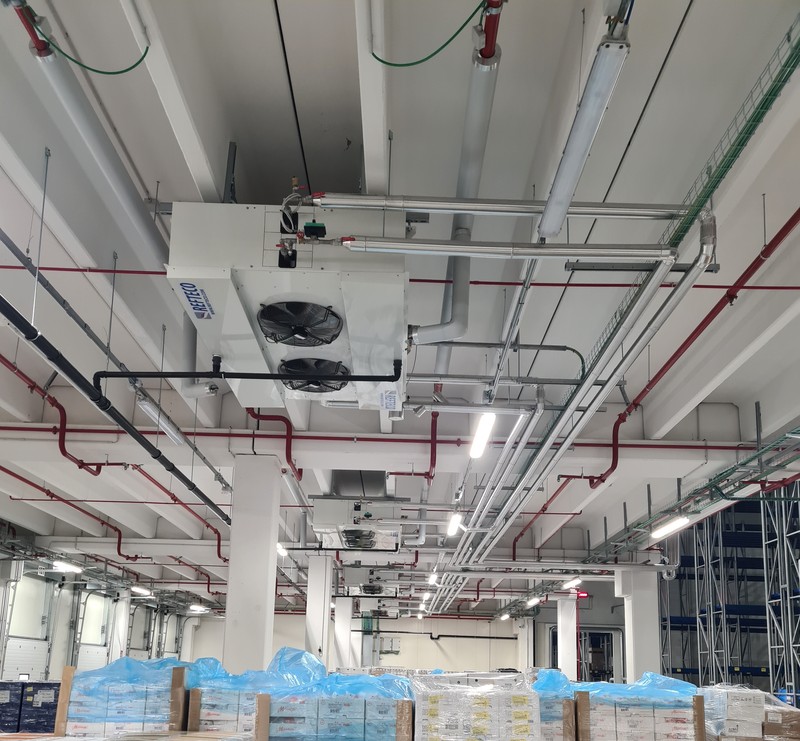
At Refteco we develop tailor-made industrial unit coolers, designed starting from the refrigerant, the load profile and the plant’s specific environmental conditions.
We analyse:
- the refrigeration cycle configuration
- the real operating ΔT
- the refrigerant distribution
- the environment’s corrosive conditions
- the long-term energy-efficiency goals
If you are designing a new plant or considering an upgrade towards CO₂, NH₃ or secondary-fluid solutions, let’s discuss your process data.
An evaporator correctly integrated into the system is not a cost: it is a variable that directly affects consumption, stability and operating margins.

REFrigeration TEchnological COmponents
For more information