High-efficiency urban cooling: meeting the constraints of modern cities
In today’s cities, the notion of comfort has changed profoundly. It is no longer enough to guarantee controlled temperatures inside residential buildings, hotels or public infrastructure: thermal comfort must now coexist with acoustic comfort, energy efficiency and a growing focus on urban integration.
In high-intensity urban HVAC applications, the challenge is twofold. On one hand, the thermal loads demanded by ever more efficient buildings are rising; on the other, the available space shrinks and the limits set by acoustic regulations, architectural constraints and planning rules become ever stricter. In this scenario, “invisible” cooling becomes a necessity.
It is on this balance that Refteco bases its approach to high-efficiency urban cooling, built on a quiet-by-design philosophy in which noise control is not a corrective measure, but an engineering goal integrated from the design stage.
The regulatory framework and the challenge of urban acoustic comfort
In sensitive urban areas — residential, hotel or public-use — noise regulations impose strict limits on the sound emissions of HVAC systems, often differentiated between daytime and night-time.
Meeting these limits is not an optional requirement, but a necessary condition for authorising and operating the system. And exceeding them does not only entail administrative penalties: in practice, it also triggers a series of corrective measures — sound-absorbing barriers, local screening or forced reductions in operating regimes — that take up space, increase costs and, above all, penalise the system’s thermal performance and energy efficiency.
In this scenario, noise becomes a genuine hidden cost of the HVAC project, with direct impacts on schedule, budget and the overall quality of the work.
Case study – Low-noise residential cooling
In the air-conditioning project for a new residential complex in Kraków, with an installed cooling capacity of 1,120 kW, noise control was one of the most critical design constraints. The system had to guarantee the apartments’ thermal comfort year-round while ensuring residents’ comfort, particularly at night.
Refteco’s solution involved installing dry coolers equipped with EC fans, managed by a dedicated controller for continuous speed modulation. This configuration was paired with AxiTop diffusers, designed to reduce turbulence and outlet sound pressure. The result is a quiet, efficient HVAC system able to meet acoustic limits without resorting to downstream corrective solutions.

Noise control in dry coolers: EC fans and AxiTop diffusers
In urban cooling, the main source of noise is the ventilation system. The sound level depends not only on installed capacity but on how the fans operate: traditional systems with AC fans, controlled ON/OFF or in steps, are often forced to run at high speeds even under partial load, generating noise peaks and operating far from the point of maximum aerodynamic efficiency.
EC fans are today the technological standard for high-efficiency urban HVAC systems. Continuous speed control makes it possible to match the airflow to the real load, cutting both noise and energy consumption.
Alongside speed control, an equally important role is played by the quality of the airflow leaving the fan. AxiTop diffusers, which stabilise the fan’s outlet airflow, reduce one of the main sources of aerodynamic noise — turbulence — without penalising the unit’s thermal output.
Case Study – Quiet cooling for a hotel (Poland)
For the cooling system of a high-end hotel in Gdynia, with an installed cooling capacity of 830 kW, acoustic comfort was an essential requirement: in a hospitality venue, noise directly undermines the quality of the guest experience.
Refteco supplied an RDVD-series dry cooler, equipped with low-speed EC fans and AxiTop diffusers. The unit achieved an A++ efficiency class and a level of 40 dB(A) at 10 metres, showing how energy efficiency and quietness can coexist in high-end urban HVAC applications.

Load variability and intelligent control in urban systems
The city is not a static system. Thermal demand varies over the course of the day, as do ambient conditions and the applicable noise limits. A system designed to always run at maximum load generates needless noise and consumption precisely in the most sensitive hours.
Intelligent control of the fans and main components makes it possible to adapt the system’s operation to real conditions, keeping the balance between thermal performance, energy efficiency and acoustic comfort.
Case Study – Dynamic control in an urban context
In the air-conditioning project for part of Vänersborg town hall, the complexity lay not so much in the required capacity (502 kW) as in the residential area in which the administrative office had to operate.
Refteco’s solution included a controller for dynamic fan-speed regulation, able to optimise performance and sound emissions over the course of the day. The result is a system that adapts to urban rhythms, reducing noise when the load allows, without sacrificing reliability.

Architectural integration of urban HVAC systems
Not just efficiency and quietness: in urban settings, the visual impact of cooling equipment is a further design constraint. Landscape restrictions, planning regulations and architectural sensitivities call for compact, visually integrated solutions that minimise the machines’ visual footprint.
In these scenarios, the most common mistake is treating aesthetics as a secondary problem, to be solved with extra screening or stop-gap solutions that increase bulk, cost and maintenance complexity. In reality, effective architectural integration starts upstream, when the form, footprint and layout of the components become an integral part of the HVAC project.
Case Study – Low-profile dry cooler for an urban context
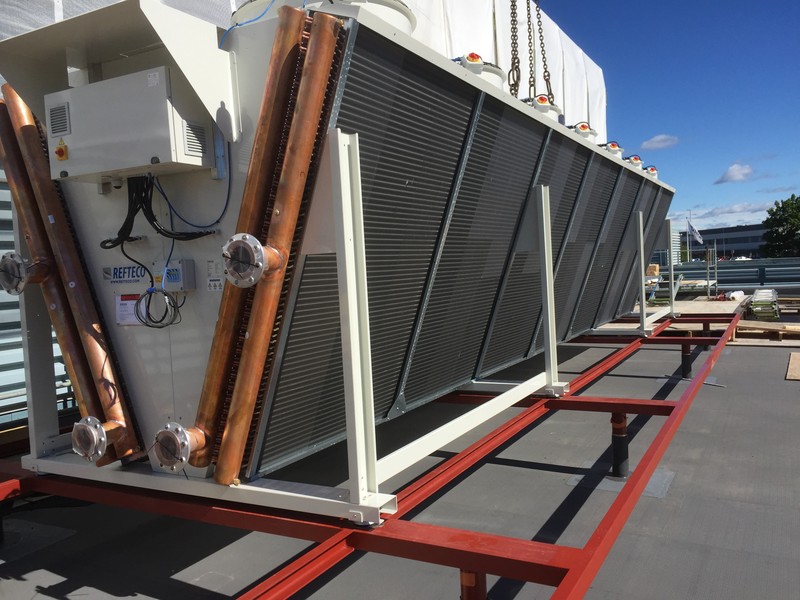
For the cooling of an ice rink in Vantaa, with a capacity of 850 kW, the urban context and the plant’s public use called for particular attention to visual impact.
Refteco’s solution was a low-profile, compact dry cooler, designed to reduce the unit’s overall height and limit the plant’s visual presence. The use of EC fans made it possible to maintain high performance even with compact geometries, avoiding the need for additional structures or intrusive screening.

All these projects share a common approach: cooling is never an isolated machine, but an integral part of the urban environment in which it operates. Aesthetics, noise, energy efficiency, load variability and reliability are variables that must be designed together.
It is this systemic vision that sets apart Refteco’s approach to designing high-efficiency urban HVAC systems: tailor-made solutions, built around the real constraints of the context, to turn seemingly incompatible limits into reliable, quiet and efficient systems.
Does your next urban project face complex acoustic or space constraints?
Start a co-design session with Refteco today and make cooling the quiet heart of the city.

REFrigeration TEchnological COmponents
For more information