Frozen-Food Refrigeration: Engineering the Cold in Freezing Tunnels and Storage Cold Rooms (Part 2)
Part 1 covered rapid freezing in the tunnels and frost management on the unit coolers. Once the thermal transformation is complete, a second cold-chain challenge begins: maintaining the product quality achieved during blast freezing.
Storage requires a different thermodynamic balance than blast freezing . The goal shifts from moving heat fast to holding stability, temperature uniformity, and service continuity under critical conditions.
In large-volume cold rooms, automated warehouses, and low-temperature distribution hubs, small design errors compound. A poorly designed exchanger, a weak defrost logic, or a single cold break can spoil entire product batches. The impact lands directly impacting operating costs and food safety.
Storage design is therefore not an extension of the tunnel. It calls for high-reliability machines, functional redundancy, materials rated for severe cycles, and solutions that anticipate F-Gas and environmental rules. Across the system, industrial unit coolers work with industrial condensers and refrigeration condensers: together they stabilize condensing pressure and, with it, the thermal regime.
This second article examines the technical and design choices behind ammonia storage cold rooms and dual-circuit industrial systems. The focus: cold continuity, seasonal efficiency, and long-term operational sustainability.
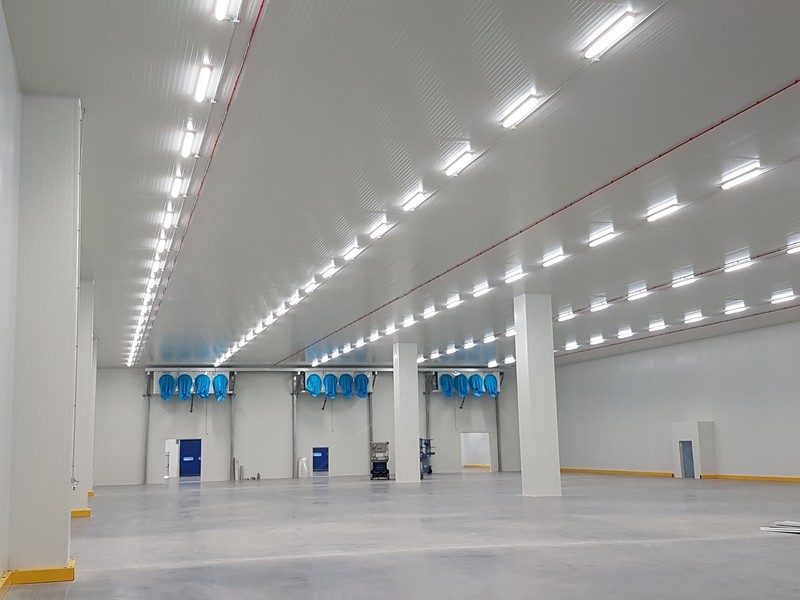
Designing for Sustainability: Ammonia Storage Cold Rooms
The second key design area is sustainability and cooling capacity. In high-capacity plants — automated storage platforms for meat or protein products — the target is 24/7 operational continuity. And it must meet the new F-Gas Regulation (EU 2024/573).
Here, ammonia (R717) is the strongest technical choice. It is a natural refrigerant with GWP = 0 and ODP = 0, and its efficiency stands out in low-temperature applications.
Refteco’s Engineering Solutions
Refteco developed a range of pumped-circulation unit coolers for NH₃, built on specific geometries and fully compatible materials:
- Ø16 mm stainless-steel tubes and wider fin spacing (10–12 mm) prevent frost clogging and extend mechanical life;
- Hot-gas or hot-glycol defrost integrated into coil and drip tray, with thermodynamic process control to minimize thermal shock.
Together, these measures sustain high specific cooling capacity and cut defrost frequency versus traditional solutions.
Case Study: Automated Cold Room – Verolanuova (BS)
At the automated platform in Verolanuova, a frozen-meat store, Refteco supplied pumped ammonia (R717) unit coolers for a 464 kW plant.
The solution deployed:
- Industrial cubic unit coolers RN – RNLA for NH₃ with Ø16 mm stainless-steel tubes (NH₃- and low-temperature-compatible) and 10–12 mm fin spacing for better frost control.
- Hot-gas defrost in coil and drain pan — total absence of ice after one month of operation.
- Fans up to Ø910 mm for flow uniformity in large-volume cold rooms.
- Anti-corrosion components with coated casings and stainless-steel hardware.
Operational result: after a month of continuous full-load running, coil and collection pan showed total absence of ice. The hot-gas defrost and the plant’s thermal stability performed as designed.

The Reliability Challenge: Cold Continuity and Product Safety
Rapid freezing optimizes for power. Storage optimizes for stability. Here the priority is long-term thermal stability: temperature homogeneity across the full cold-room volume, and functional redundancy against any cold break.
In frozen food, every cold-chain break is lost value. A fault, a sizing error, or a defrost malfunction can compromise entire production batches — with real economic and reputational cost.
In logistics plants and distribution hubs, these demands require robust, modular solutions that hold continuity even during a partial shutdown.

The Refteco Answer
The RN industrial cubic unit cooler series is the most versatile platform for these applications:
- Independent dual-circuit exchangers keep the unit running even if one refrigeration line fails;
- High-static-pressure fans with optimized profile deliver an air throw up to 60 meters and even temperature distribution;
- Thicker fins with adjustable spacing (4–12 mm) match the operating temperature;
- Combined defrost options (electric, hot gas, hot glycol) suit the plant configuration.
Case Study: Storage Cold Rooms – Agios Stefanos (Greece)
For a leading Greek producer of frozen snacks and french fries. s, Refteco supplied two dual-circuit unit coolers (239 kW installed) to expand an existing plant. Tight space required a bespoke engineering approach.
The solution:
- Coils with two interlaced independent circuits combine high capacity and operational safety in one body;
- Galvanized, powder-coated structure with AISI 304 stainless-steel hardware for corrosion resistance.
- Exchangers with high-thickness fins, for long mechanical life and stable performance.
- High-static-pressure fans with extended air throw for uniform temperature across the cold room.
Result: a stable isothermal regime and service continuity even during a partial shutdown — lower maintenance cost and higher overall reliability.
Beyond the Standard: Refteco’s Applied Engineering
Storage cold rooms are the most demanding segment of the cold chain. This is where a plant must prove constant thermal stability — independent of load cycles, outdoor conditions, and warehouse operations.
So Refteco engineers for service continuity and lower operational risk: NH₃-rated exchanger materials, dual-circuit layouts for refrigeration redundancy, defrost systems that avoid thermal shock, and geometries that limit frost.
The design logic goes beyond installed capacity. It weighs specific energy per tonne handled, thermal-regime stability, behavior under partial shutdown, and the impact of defrost cycles on the whole plant’s energy balance. These measurable variables define the real value of an industrial storage cold room.
Every production context sets different constraints — tight space, strict regulations, sensitive products, automated warehouses. The design adapts to them, not the reverse.
Planning a storage-cold-room upgrade or a new plant? Our engineers are available for a dedicated analysis. We build systems that deliver not just cold, but operational continuity, product quality, and long-term sustainability.

REFrigeration TEchnological COmponents
For more informations