The Engineering of Refrigeration in the Meat and Fish Sector
In a slaughterhouse or a fish-processing plant, refrigeration is an integral part of the production process. Every batch must meet precise timings for chilling, processing, and packaging, because every extra degree of temperature or every hour of uncontrolled exposure is a direct risk to food safety (HACCP), product quality, and regulatory compliance.
The challenge, however, is not only about thermal performance. Salt-laden air, frequent washdowns with corrosive substances, and strict hygiene standards put materials and machinery under pressure. This is a sector where equipment must be as rugged as it is precise, able to run without failure in environments of high corrosive and thermal stress.
That is why Refteco does not just supply refrigeration units: it engineers integrated solutions built around the customer’s production cycle, designed to guarantee continuity, efficiency, and durability even in the most extreme conditions.
1. The Safety Challenge: Microbiological Control and Product Quality
In meat and poultry processing, cold is the first line of food-safety defense. In rapid-chilling tunnels, chilling that is too slow encourages bacterial growth and causes weight loss, with a direct hit to economic yield. In processing rooms, the challenge is different: the air must circulate evenly and under control, enough to hold the cold chain but without creating drafts that drafts that could discomfort personnel working long hours in production areas.
The Refteco Answer: Targeted Cooling
To command the fluid dynamics of cold with precision, Refteco has engineered specific solutions for both scenarios:
- in rapid-chilling tunnels, as at the Ragusa poultry slaughterhouse, we use RN industrial cubic unit coolers. Built for heavy-duty applications (−40 to +25 °C), they feature large-surface coils and special high-static-pressure fans that deliver a powerful, uniform airflow across the entire product mass. Supporting them, we also install RGDC commercial dual-discharge unit coolers, ideal for ancillary cold rooms and loading/unloading bays.
- In processing rooms (as at the Cossé-le-Vivien slaughterhouse), the RN cubic unit coolers in the CO₂ version (RNSB) are fitted with soft-start EC fans and are ready for textile ducting. This configuration ensures a stable, low-turbulence microclimate, improving staff comfort and reducing the risk of cross-contamination.

2. The Durability Challenge: Withstanding Aggressive Environments
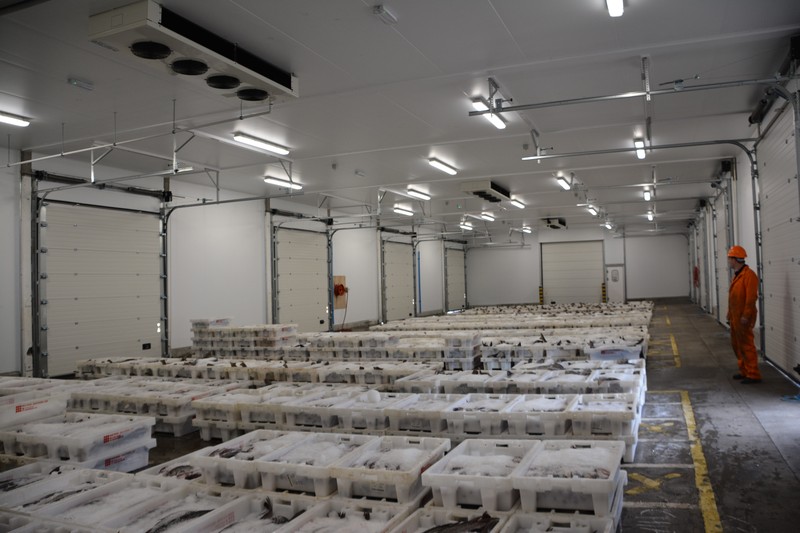
The fish-processing areas of seafood plants are among the toughest tests for a refrigeration system. Saline atmospheres, constant humidity, and washdowns with aggressive disinfectants (e.g., peracetic acid) push materials and components to the limit.
Built in copper, aluminum, or galvanized steel, heat exchangers degrade quickly: corroded fins, weakened frames, oxidized screws. Beyond breakdowns and downtime, this means rising costs and hygiene risks.
The Refteco Answer: Materials Engineering
To ensure durability and continuity, Refteco applies a targeted approach based on resistant materials and protective treatments:
- AISI 316L stainless steel. The go-to material for marine environments or frequent washdowns, used for coils, framework, hardware, and grilles. It is the solution adopted, for example, in the salmon-processing room in the Orkney Islands, where the REDI – RBDI – RADI industrial dual-discharge unit coolers withstand daily washdowns with peracetic acid.
- Cataphoresis (e-coating) treatment. The heat exchanger is immersed in an electrolytic bath that deposits a uniform protective film over tubes, fins, and frame. This process, applied in the seafood plant in Kinlochbervie, Scotland with the REDC-RBDC commercial dual-discharge unit coolers, guaranteed steady performance in an environment saturated with salt spray.
- Pre-coated fins or special alloys. Used in condensers exposed to heavy salt loads, they slow oxidation and extend the machines’ service life.

3. The Comfort Challenge: Hygiene in Processing Rooms
A refrigeration system must not only hold the cold chain: it must also ensure a safe, comfortable environment for the people working in it, while protecting the packaged product. Noise and condensation are two underrated problems that can affect both staff wellbeing and the quality perceived by the end customer.
The Refteco Answer: Designing with the Working Environment in Mind
Our solutions tackle the two most recurring problems:
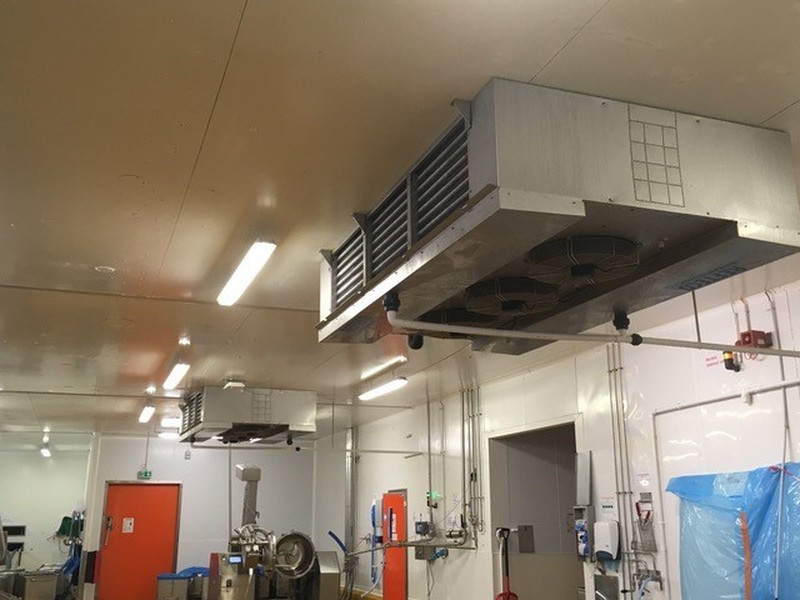
- Cutting noise. In processing areas staffed by operators, Refteco uses REDI – RBDI – RADI industrial dual-discharge unit coolers with 6-pole fans. This solution, adopted in the fish-processing room in Les Lucs-sur-Boulogne, delivers low noise emissions together with resistance to washdowns with aggressive detergents.
- Preventing condensation and protecting packaging. In cold rooms storing packaged product, Refteco uses unit coolers with an insulated drain pan, available both in the REDI – RBDI – RADI range and in the compact REC – RBCT line. This is the case at the fish cold-storage rooms in Les Lucs-sur-Boulogne, where the insulated pan and AISI 316L framework eliminated the dripping problem, protecting the integrity of the packaging.
Refteco does not supply mere components: it engineers results. Every system starts from concrete goals — microbiological safety, corrosion resistance, operational efficiency — and is built around the real process. Our value is not in the product range, but in the ability to integrate technologies that turn refrigeration into a measurable competitive advantage.
Your challenge is unique. Our solution will be just as unique.
Contact our experts to design together a system that protects and enhances your products.

REFrigeration TEchnological COmponents
For more information