Refrigeration for the Deep-Frozen Food Sector: Cold Chain Engineering in Blast Freezing Tunnels and Cold Storage Rooms (Part 1)
In the industrial deep-freezing sector , reaching −18°C is only the starting point of the cold-management challenge. In a modern plant, where low temperatures are an integral part of production dynamics, chilling times, airflow speed, relative humidity, temperature distribution, and the cycle’s energy efficiency are design parameters that matter just as much, to be optimized around the production cycle.
Every food product and processing line demands a dedicated thermodynamic profile: seafood must cross the water-crystallization zone extremely rapidly to prevent large ice crystal formation, whereas vegetables require controlled ventilation to avoid dehydration and product mass loss.
In the frozen-food sector, two stages are critical for the cold chain:
- Blast freezing (tunnels): The transformation phase where raw product transitions from fresh to deep-frozen, and where process throughput (kg/h) directly determines final product quality.
- long-term storage (cold rooms): the holding stage, where thermal-regime stability and operational continuity impact food safety and energy costs.
Designing frozen-food plants means defining different strategies for these two process logics: rapid freezing demands high-static-pressure, high-ΔT machines, while storage favors stability, seasonal efficiency (COP), and smart defrost management.
In this article, then, we look at rapid tunnel freezing and its challenges, before exploring in the second part the world of storage rooms and operational continuity.
The Efficiency Challenge: Frost Control in Rapid-Freezing Tunnels
In deep-freezing plants, frost accumulation on the air evaporator heat exchanger is the leading cause of performance degradation. When moisture suspended in the air or released by the product comes into contact with the finned surface of the evaporator, ice forms, creating a double bottleneck:
- Thermal resistance: The frost layer insulates the active heat transfer surface area, obstructing heat rejection.
- Aerodynamic resistance: The free area between the fins narrows, severely penalizing the effective volumetric airflow rate.
As a result, the system is forced to run longer cycles with higher power consumption just to maintain the target operating temperature. Inefficient frost management can increase OPEX (operating expenses) by up to 30%, while compromising product quality and room temperature stability.

The Refteco Solution
Refteco addresses frost accumulation at the core engineering stage, optimizing fin geometries and defrost configurations:
- Wider fin spacing (10–12 mm): Specially engineered to minimize frost occlusion and maintain a stable airflow rate.
- High-efficiency defrost systems:
- hot gas, which harnesses residual energy from the compression cycle;
- hot glycol, for heat recovery and shorter off-regime times.
Real-World Application: Freezing Tunnel – Canary Islands
Food & Beverage plant in Lanzarote (Spain)At the production complex of a Food & Beverage plant in Lanzarote (Spain), Refteco supplied a complete system for a freezing tunnel and a low-temperature cold room, with a total cooling capacity of 174 kW, installed in a marine environment with high humidity and salt.
Technical solution:
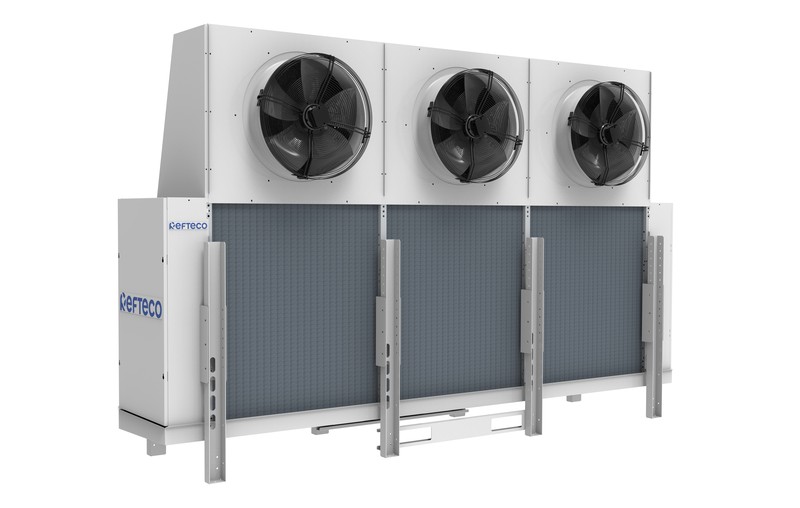
- REBFT – RBBFT – RABFT• three Shock Freezer REBFT – RBBFT – RABFT unit coolers, configured for high-velocity flows and space-constrained installations.
- RCSD – RCLD• table condensers RCSD – RCLD with cataphoresis-treated coils, resistant to the saline atmosphere, and factory-wired fans to cut installation time.
The Result: Reduced defrost frequency, maintenance of nominal design airflow, and rock-solid thermal stability even under high ambient humidity. A system precisely dimensioned to withstand marine environments and deliver consistent, long-term performance.

Beyond the Standard: Refteco’s Applied Engineering
Every project starts from a simple but often overlooked principle: the technology must fit into the process, not force the process to adapt to the machine. Every configuration must be developed considering environmental, regulatory, and production constraints, calibrating parameters like ΔT, air throw, fin spacing, and defrost logic around the product and the operating cycle.
Refteco design is not standardized: it is tailor-made engineering, aimed at achieving measurable, repeatable performance over time. Every system is built to measure efficiency not only in kilowatts, but in operational continuity, product quality, and economic sustainability.
Your challenge is unique. Our solution will be just as unique, whether it is a rapid-freezing tunnel or a storage cold room.
Contact our engineers to discuss your needs and design together a system that turns refrigeration into a competitive advantage.

REFrigeration TEchnological COmponents
For more informations