Cooling the Ice: The Hidden Challenge of Ice Rinks
Behind the magic of an ice rink runs a complex system that must operate continuously and in a modulated way to keep the ice sheet in optimal condition. This is not just about “making cold”: it means balancing energy, thermodynamics, and reliability in a constant equilibrium.
season typically consume 1 to 3 kWh per square meter per day. For a 200 m² surface, that means 6,000 to 18,000 kWh a month. Permanent installations — far larger and in intensive use — easily exceed 1,000 MWh a year, with refrigeration alone accounting for 40% to 60% of total electricity demand.
On top of this economic pressure comes a second factor, less visible but just as pressing: European regulations — in particular the F-Gas Regulation (EU 2024/573) — which mandate the progressive phase-out of high-GWP refrigerants. A challenge that renders many traditional plants obsolete and forces operators to rethink their technology strategies.
Regulations: From Constraint to Opportunity
With the F-Gas Regulation now in force, the future of ice rinks will inevitably rely on natural refrigerants. The deadlines are firm:
- From 2027: new chillers >12 kW using gas with a GWP above 750 can no longer be installed.
- From 2030: new stationary refrigeration systems using refrigerants with a GWP ≥ 150 will be banned.
- From 2025: virgin gases with a GWP ≥ 2500 can no longer be used for maintenance (e.g., R-404A).
Choosing natural refrigerants like CO₂ (R-744) or ammonia (R-717) is not just a way to stay within the rules — it is a strategy to give the plant a long-term horizon, shielded from the risk of obsolescence.
Upgrading a plant thus becomes the chance to optimize the entire system. The technological answer runs through key components that make the difference on operating costs:
- EC fans: modulate speed to match the load, cutting consumption by up to 30%.
- Adiabatic dry coolers: use air humidification to sustain high performance even during summer peaks.
- Variable frequency drives (VFDs): dynamically regulate compressors and pumps, avoiding waste and reducing mechanical stress.
The Refteco Answer: Compact Efficiency with RDVS
Against this backdrop, Refteco developed the RDVS dry coolers with V-shaped coils, a dedicated solution that resolves energy, regulatory, and architectural constraints.
- Discreet design: at just 115 cm tall, RDVS units tuck away easily even in historic centers and residential areas.
- Wide power range: from 80 to 920 kW, for temporary rinks and permanent arenas alike.
- Efficiency and quiet operation: high-efficiency heat exchangers dissipate large loads even at low fan speeds.
- Built to last: anti-corrosion casings, stainless-steel hardware, and designs that prevent air recirculation.
- Full customization: EC fans, adiabatic systems, and accessories for maintenance and safety.
In short: maximum efficiency, minimal footprint. A modular platform to configure the unit around power, climate, planning constraints, and primary refrigerant (NH₃, CO₂, low-GWP HFO/HFC).

The Vantaa Case: Where Efficiency Meets Aesthetics
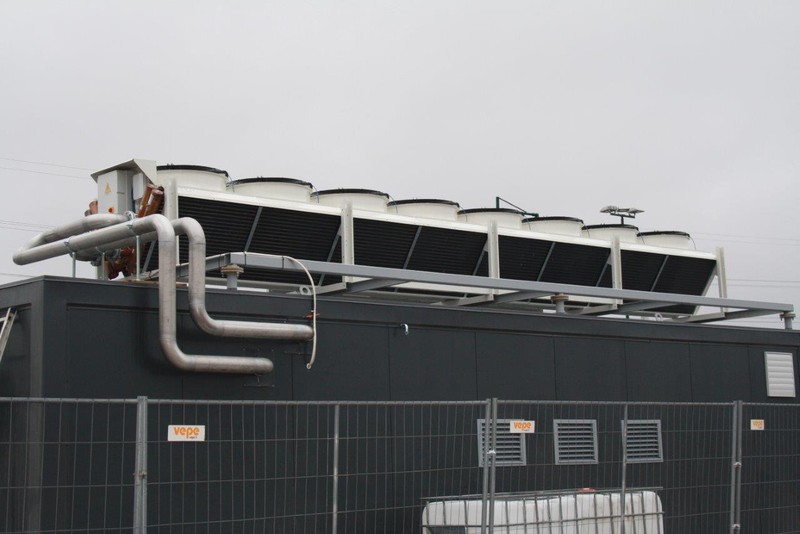
A concrete example comes from Finland. In Vantaa, Refteco supplied an 850 kW RDVS dry cooler with EC fans for an ice rink.
The unit was chosen not only for its performance, but for its ability to blend into the urban setting. Thanks to its compact, low-profile structure, it fits in with no visual impact. On top of that, each fan was fitted with an independent maintenance switch to guarantee maximum safety during maintenance.
For ice rinks, investing in modern technology means:
- Cutting energy costs significantly.
- Future-proofing the plant against upcoming regulations.
- Harnessing recovered heat for other uses (hot water, heating).
- Ensuring reliability and operational continuity.
- Delivering a better experience for athletes and spectators.
Refteco does not offer off-the-shelf machines, but tailor-made engineering solutions. Engineering value, not just cold: that is the difference Refteco technology makes.

Want to understand how to cut your rink’s costs and shield it from future regulations?
Talk to the Refteco engineers: we will turn your challenge into an efficiency project.

REFrigeration TEchnological COmponents
For more informations